Bill of Materials
The recipe for every finished product (raw materials, quantities, and scrap percentages) automatically scaled for any production batch size.
- One standard recipe per product
Every BOM captures the exact materials and quantities in one place, so every production run follows the same specification regardless of who's managing it.
- Automatic material calculations
Enter the batch size and the system scales every component for you. A BOM designed for 1,000 units scales perfectly to a run of 250.
- Wastage built into planning
Each component supports a scrap percentage, so expected waste is factored in upfront. No more running short mid-production.
- Full manufacturing history
Every production order links back to its BOM, and each BOM shows every run it powered: a complete audit trail of what was made and how.
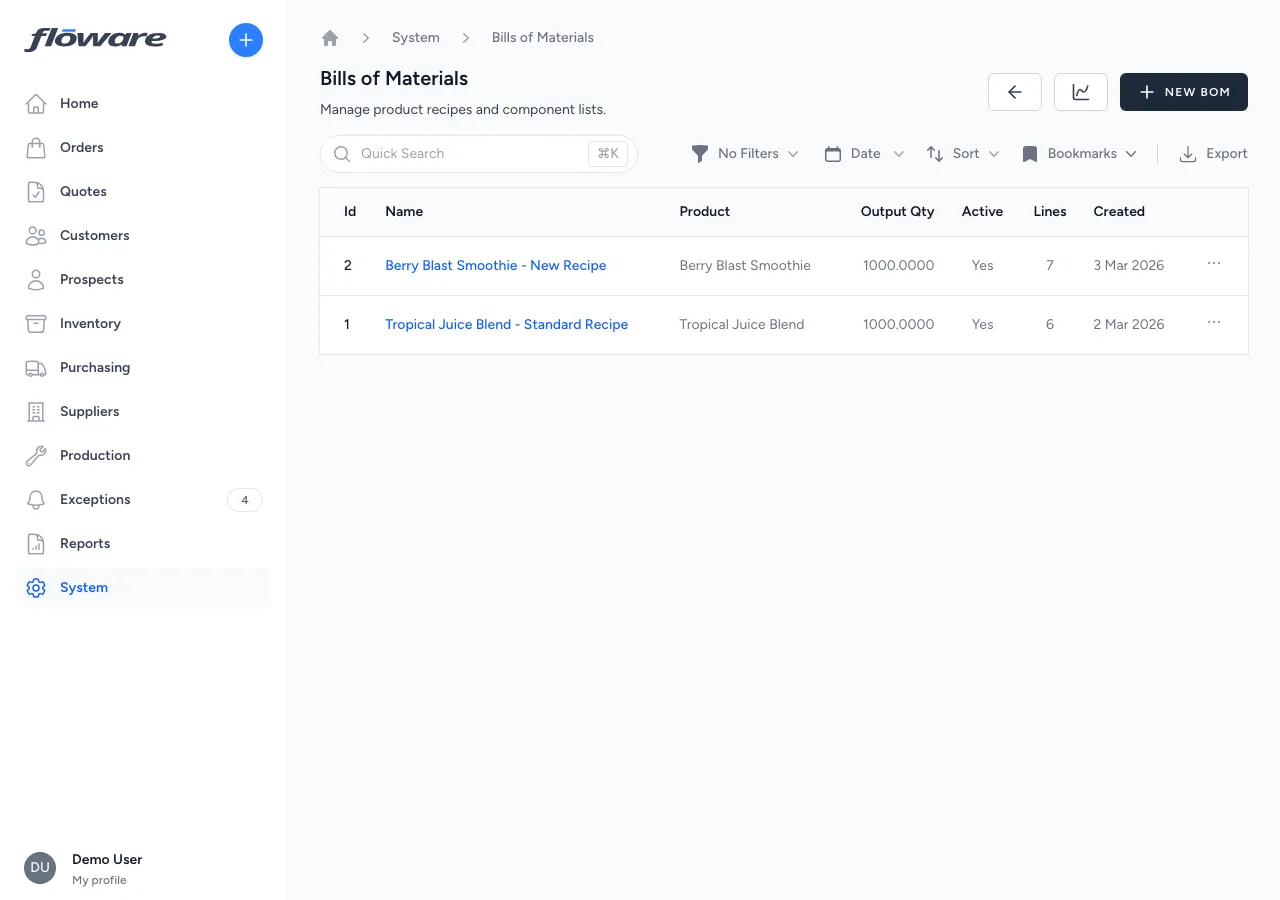
What it does
Defines the recipe or formula for manufacturing a finished product, listing every raw material, the quantity needed, and an optional scrap percentage to account for expected waste. When a production order is created from a BOM, the system automatically calculates the exact material requirements based on the planned output quantity.
What it replaces
Without this, recipes and formulas typically live in spreadsheets, paper documents, or the production manager's head. Every time a production run is planned, someone has to manually calculate how much of each ingredient is needed and check whether there's enough stock, a slow, error-prone process.
Who it's for
Any manufacturer that assembles, blends, or transforms raw materials into finished products. This includes food and beverage producers managing recipes, chemical companies tracking formulations, cosmetics manufacturers with ingredient lists, and assembly operations with parts lists. Particularly valuable for businesses running the same product repeatedly at different batch sizes. The BOM handles the scaling automatically.
What problems it solves
- Recipes and formulas aren't standardised. A BOM captures the exact materials and quantities needed for each product in one place, so every production run follows the same specification regardless of who's managing it.
- Manual material calculations waste time and introduce errors. When you create a production order, the system automatically scales each component quantity based on the batch size you enter. A BOM designed for 1,000 units scales perfectly to a run of 500 or 2,500.
- Material waste isn't accounted for in planning. Each component line includes an optional scrap percentage, so the system factors in expected waste when calculating material requirements. No more running short mid-production because wastage wasn't planned for.
- No visibility into which production orders used which recipe. Every production order links back to the BOM it was created from, and the BOM detail page shows all associated production orders, giving a complete manufacturing history for each formula.
- The recipe changed and nobody can say what it used to be. With revision control switched on, every edit records a numbered revision with change notes and the person who made it, and each production order remembers the exact revision it was built to. See BOM Revision Control for the full story.