Production Lot Tracking and Genealogy
Carry batch traceability through the factory: production consumes specific raw-material lots, stamps a lot number on the finished goods it makes, and records the link between them, so you can trace a finished batch back to every raw lot that went into it, and a suspect raw lot forward to every finished batch and customer it reached. Farm-to-fork recall, built in.
- Trace a finished batch to its ingredients
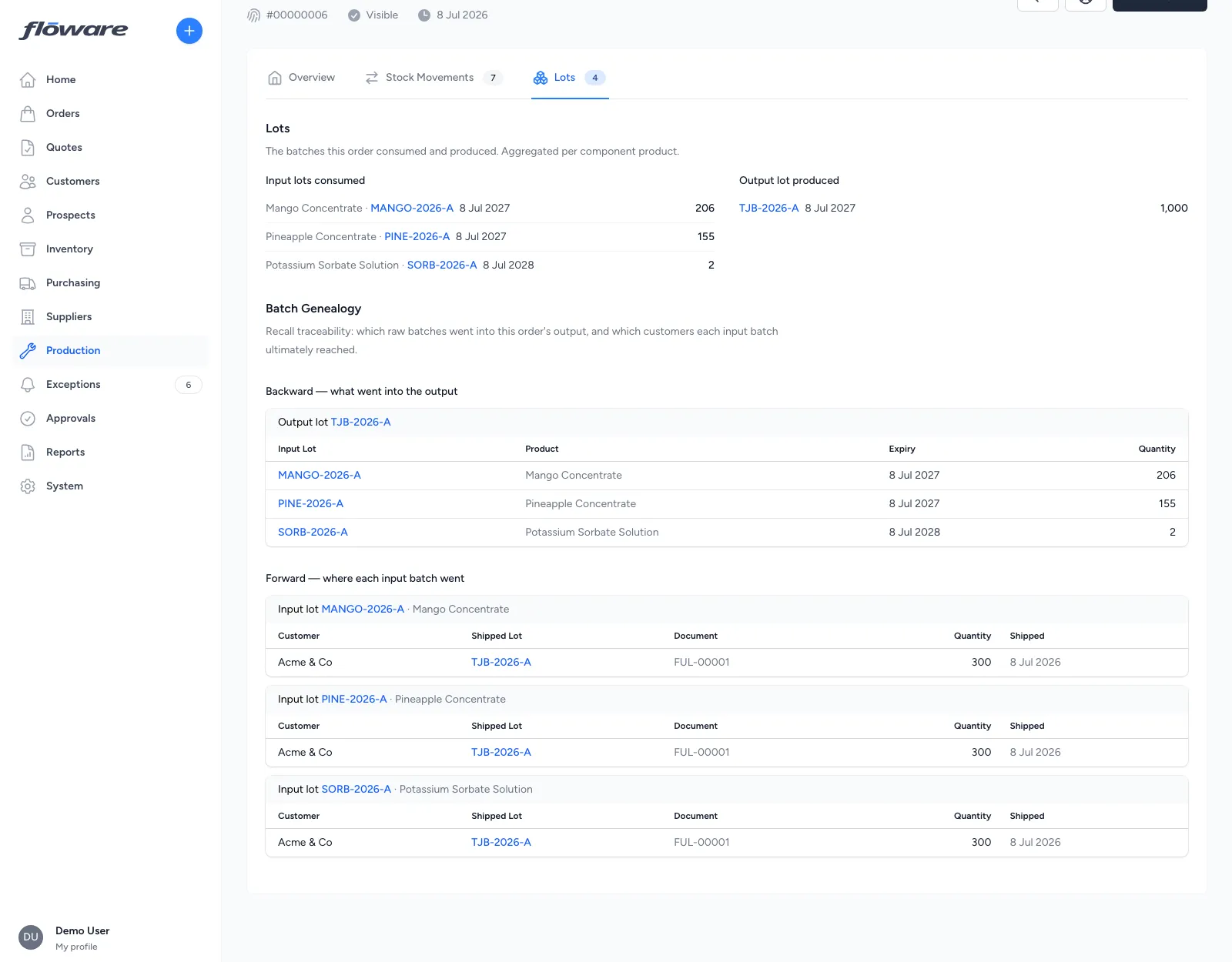
From any finished-goods lot, see every raw-material lot that was consumed to make it: the answer to "a customer complained about batch 4471, what went into it?" in one view instead of a day in the filing cabinet.
- Recall forward to the exact customers
From a suspect raw-material lot, trace forward to every finished batch it became and every customer that received them, so a recall hits only the affected stock, not your whole run.
- Oldest raw materials consumed first
Production automatically draws from the earliest-expiry raw lots (FEFO), with a manual override when a specific batch is staged at the workstation, recording what was actually used, not a guess.
- Output batches, numbered and dated
Finished goods get a generated (or operator-set) lot number and expiry automatically, so the batch you just made is ready for FEFO rotation and traceable from the moment it exists.
What it does
Extends lot and batch tracking into the manufacturing process. When a production run records output, it consumes its raw-material components from specific lots, chosen automatically by earliest-expiry (FEFO), or overridden by the operator when a particular batch is staged, and credits the finished goods into a new output lot with its own number and expiry. The link between the raw lots consumed and the finished lot produced is captured automatically, building a full genealogy: backward from a finished batch to its ingredients (complaint investigation), and forward from a raw batch to the finished goods and customers it reached (recall). It builds on the inventory Lot and Batch Tracking feature and is opt-in on the same switch.
What it replaces
Replaces the manual batch records manufacturers keep to satisfy traceability: the production sheets, spreadsheets and binders that log which raw lots went into which finished batch, and the painstaking cross-referencing when a complaint or recall lands. It replaces guessing which raw materials a finished batch contained, the all-hands scramble to work out a recall's blast radius, and FEFO rotation done by eye on the raw-material shelf.
Who it's for
Manufacturers in regulated or batch-critical industries (food and beverage, pharmaceuticals, nutraceuticals, chemicals, cosmetics) who transform raw materials into finished goods and must prove what went into each batch. It is most valuable where a supplier recall or a customer complaint demands fast, exact two-way traceability, or where GMP / HACCP / FDA-style regulation requires documented genealogy. This is the production-side complement to the inventory Lot and Batch Tracking feature; manufacturers typically want both.
What problems it solves
- A complaint can't be traced to its ingredients. From the finished-goods lot, the system lists every raw-material lot consumed to make it, turning a complaint investigation from a day in the records into a single screen.
- A recall hits the whole run, not the affected batch. From a suspect raw lot, trace forward to exactly which finished batches it became and which customers received them, so a recall is targeted, defensible, and fast.
- Expired raw materials end up in a batch. Production draws from the earliest-expiry lots automatically, and an operator can override to the batch actually staged, so what's recorded is what was used, and ageing stock is consumed before it expires.
- Turning on batch tracking shouldn't break production. The record and cancel screens handle every batch-related situation gracefully (a held or short component, a wrong-product lot, a missing warehouse) with a clear message instead of an error, so a plant can enable batches with confidence.