Stock Holds and Quarantine
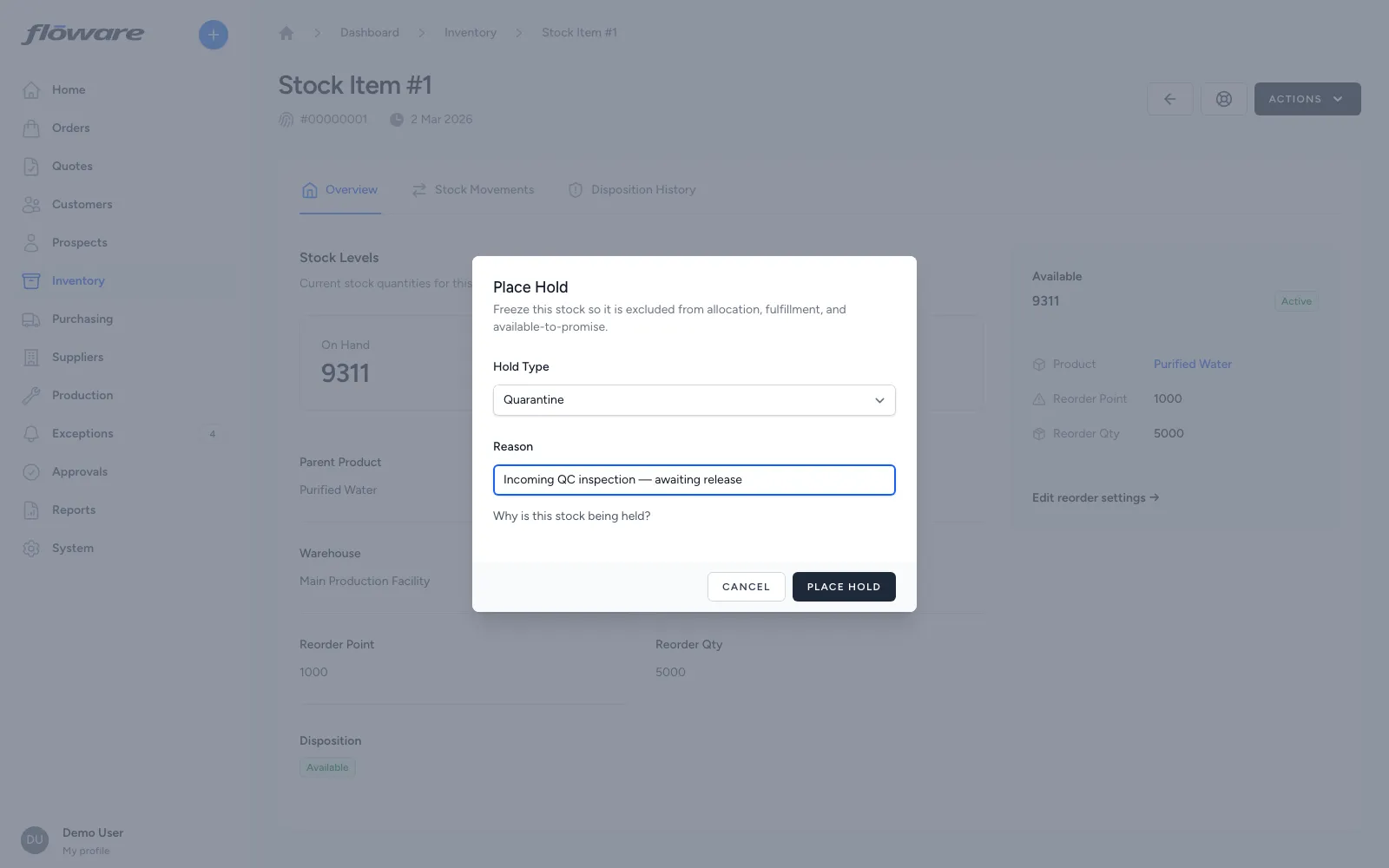
Freeze a stock item as on-hold or quarantined and it is instantly excluded from allocation, fulfillment, and available-to-promise, without destroying the quantity record. Place and lift holds from the inventory screen with a required reason, see a coloured disposition badge wherever stock appears, filter the list to held stock, and read a full who/when/why history per item.
- Held stock can't be sold
The moment you place a hold, that quantity drops out of every availability calculation: allocation, fulfillment, and available-to-promise. The stock is still physically on the shelf and still on your books; it just can't be promised to a customer until you release it.
- A reason on every hold
Placing a hold always requires a reason, and the system records who placed it and when. Quarantine for QC, set damaged goods aside, or freeze a batch for a recall. Every hold carries its context.
- See held stock at a glance
A coloured disposition badge appears wherever stock is listed, an "On Hold" tile on the inventory dashboard counts frozen items, and a single click filters the list to exactly what's held.
- An honest availability picture
Low-stock and out-of-stock signals now ignore held stock, so you never get told a product is healthy when half of it is frozen in quarantine. Reorder alerts reflect what you can actually sell.
What it does
Lets a warehouse or QC operator freeze an individual stock item by placing it on-hold or in quarantine (or any disposition your business defines). A held item stays physically counted and on your books but is automatically excluded from allocation, fulfillment, and available-to-promise, so it can never be sold or consumed while frozen. Holds are placed and lifted from the inventory screen through a simple modal that captures a required reason; the system records who acted and when. A coloured disposition badge surfaces the state wherever stock is listed, the inventory dashboard counts held items in a dedicated "On Hold" tile, the list can be filtered to held stock or a specific disposition, and each item carries a disposition-history tab showing every hold placed and lifted.
What it replaces
Replaces the spreadsheet column or sticky note that says "don't ship this", and hopes everyone reads it. Today, suspect or quarantined stock is usually kept sellable in the system and held back by memory, email, or a physical label, so it gets allocated to an order anyway and someone has to scramble to un-pick it. This makes the hold a hard system rule instead of a human reminder.
Who it's for
Any business that holds physical inventory and ever needs to set some of it aside, but it's essential anywhere stock passes through inspection or is subject to regulation. Food and beverage, pharmaceuticals, chemicals, cosmetics, and electronics all routinely quarantine incoming goods pending QC, freeze batches for recall, or isolate damaged stock pending a claim. Distributors and manufacturers who receive raw materials before releasing them to production get the most value.
What problems it solves
- Suspect stock gets sold by accident. Placing a hold removes the quantity from every availability calculation, so held stock can't be allocated to an order, picked, or consumed in production until it's released. It's a system rule, not a sticky note.
- You don't want to delete stock just to stop it shipping. A hold freezes the item while keeping the full quantity on your books and in your valuation: the stock is preserved, just not sellable.
- No record of why stock was held or by whom. Every hold requires a reason and records who placed it and when; the disposition-history tab keeps the full trail of holds placed and lifted for audit.
- Availability numbers lie when stock is frozen. Low-stock and out-of-stock counts and reorder alerts are computed from sellable stock only, so a product with most of its quantity in quarantine is no longer reported as healthy.
- Recalls are slow and manual. Affected stock can be frozen immediately across warehouses, instantly pulling it out of allocation and fulfillment without touching quantities.