Stock Transfers
Move stock between warehouses as a tracked, two-step document: dispatch from one site, receive it (even partially) at another, with the in-transit quantity visible the whole way. No more stock disappearing into a black hole between locations.
- See stock in transit
Every transfer shows what has left the source, what has arrived, and what is still on the road. The in-transit quantity is visible from dispatch right through to receipt.
- Receive partially, with confidence
When only part of a transfer turns up, receive what is there and leave the rest open. Over-receipts are blocked at the line, so destination stock can't be inflated by mistake.
- Cancel returns only the remainder
Cancel an in-transit transfer and only the un-received balance goes back to source. Stock already delivered stays put. No double-counting, no manual adjustments.
- Relocate vs transfer, made clear
Quick same-site moves stay instant as "Relocate Stock"; genuine inter-warehouse moves become a tracked transfer document, so operators reach for the right tool every time.
What it does
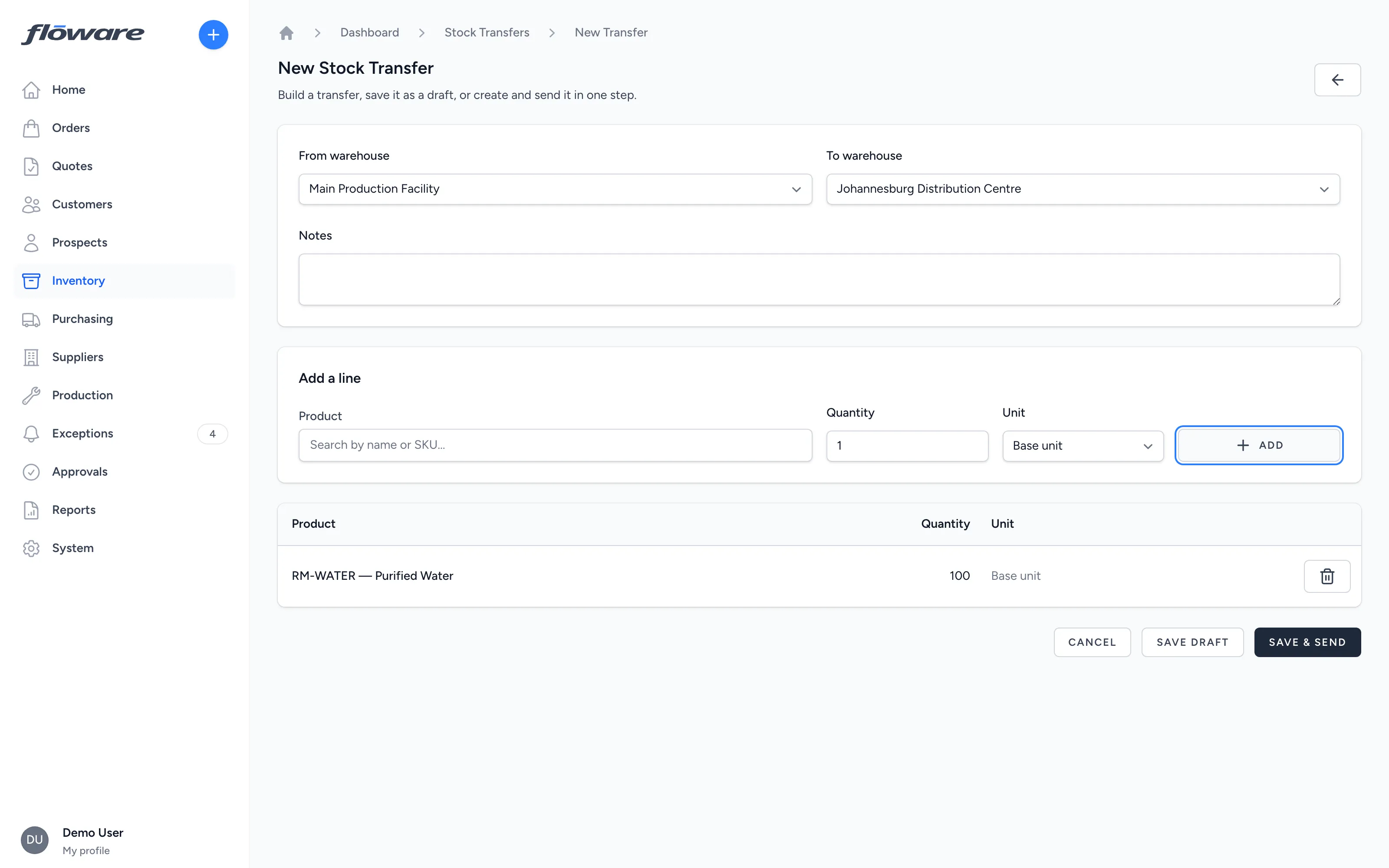
A two-step stock transfer document (reference prefix TR) for moving stock between warehouses with in-transit visibility. A user builds a transfer at the desk (source and destination warehouse, product lines with quantities and units) and saves it as a draft, or creates and sends it in one step. Sending decrements the source and puts the stock in transit. Receiving at the destination increments stock for the quantities that actually arrived, and can be done partially across multiple deliveries. Cancelling an in-transit transfer returns only the un-received remainder to the source. Throughout, the document shows quantity sent, quantity received, and remaining per line. This sits alongside the existing instant single-step move, now labelled "Relocate Stock", for quick same-site shuffles.
What it replaces
Replaces blind warehouse-to-warehouse moves where stock vanishes from one site and reappears at another with nothing recorded for the time in between, or the spreadsheets, emails, and phone calls businesses use today to track what is on a truck between branches. It also replaces forcing every move through the instant single-step transfer, which gave no in-transit visibility and no way to handle a delivery that arrived in parts.
Who it's for
Multi-site distributors, wholesalers, and manufacturers who move stock between warehouses or branches and need to know what is in transit at any moment, especially where dispatch and receiving happen at different locations, on different days, and by different people. Most valuable where transfers are large, frequent, or prone to partial or late arrival: regional distribution networks, a central warehouse feeding satellite branches, or inter-factory material moves.
What problems it solves
- Stock that disappears between sites. With an instant move, stock left one warehouse and landed in another with no record of the journey. If it was lost or delayed, nobody knew until a stocktake. The transfer document keeps the in-transit quantity visible from the moment it is dispatched until it is received.
- Deliveries that arrive in parts. A transfer of 100 units where only 60 turn up used to be all-or-nothing. Partial receipt records the 60 that arrived, increments destination stock by exactly that, and leaves the other 40 open and visible until they show up, or until the transfer is cancelled.
- Over-receiving by mistake. Receiving more than was sent on a line is blocked with a line-specific error, so destination stock can't be silently inflated by a mis-keyed quantity on the receiving dock.
- Cancelling cleanly without double-counting. Cancel an in-transit transfer and only the un-received remainder returns to source; anything already received at the destination stays there. No manual adjustments, no stock counted in two places.
- Confusing a quick shuffle with a real transfer. Same-site relocations and genuine inter-warehouse moves are now distinct actions ("Relocate Stock" for instant moves, the transfer document for tracked ones) so operators always reach for the right one.