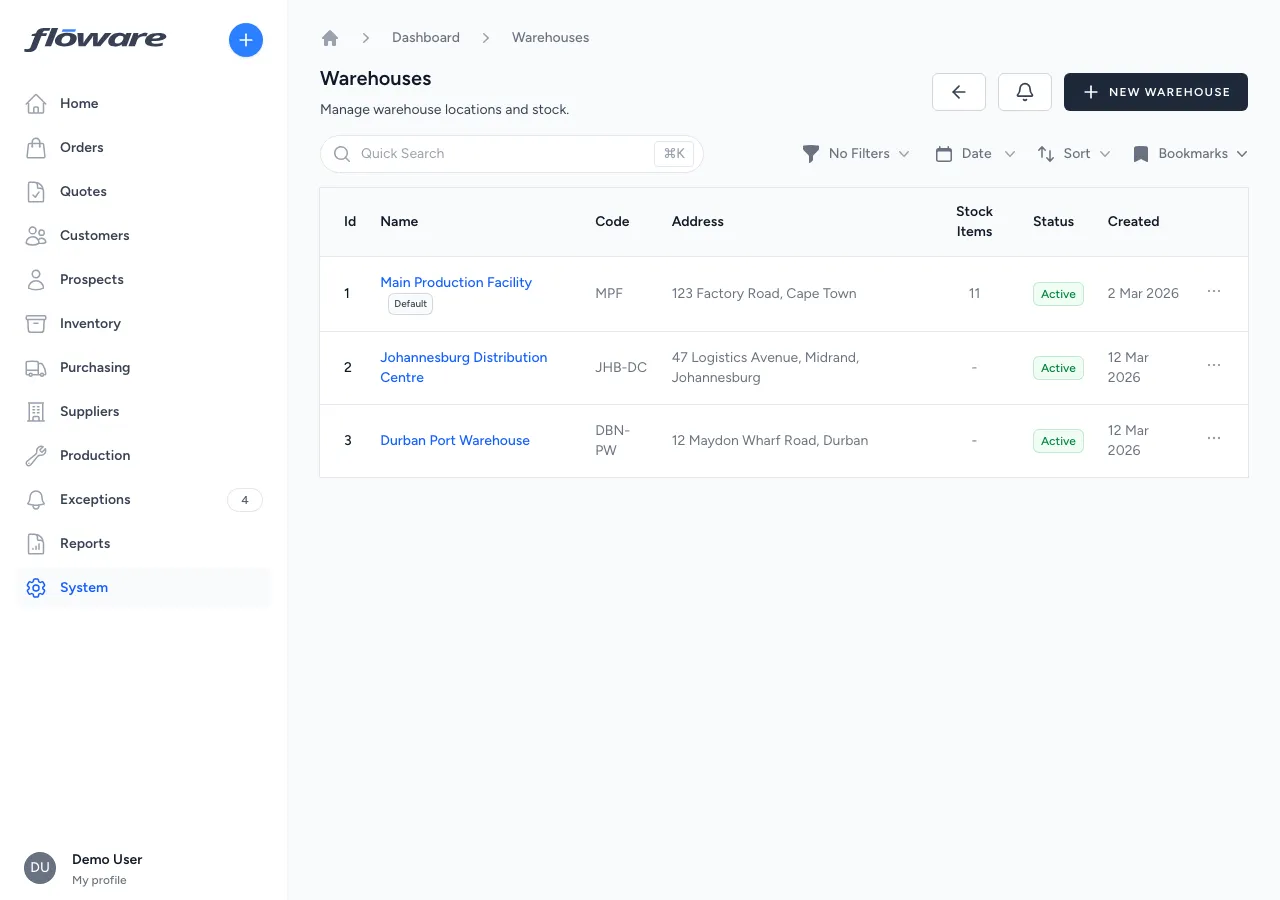
Warehouses
Manage the physical locations where your stock lives, with per-warehouse on-hand and allocated quantities, transfers between sites, and a full audit trail on every movement.
- Stock broken down by location
See on-hand, allocated, and available per warehouse per product: 300 in Cape Town and 200 in Durban, not just '500 total.'
- Default warehouse drives fulfillment
Mark one warehouse as default and fulfillment draws from it automatically. Multi-warehouse strategies allocate across sites in priority order.
- Track every transfer
Move quantities from one warehouse to another with a full movement record. Source deducts, destination adds, all in one transaction.
- Deactivate without breaking things
Decommissioning a warehouse blocks all inbound operations and shows a warning banner: no stock accidentally flows to a site that's being wound down.
What it does
Manages the physical locations where your business stores inventory. Each warehouse has a name, code, and address, and tracks every stock item within it, broken down by product, variant, and optional location. Businesses can operate multiple warehouses, with one marked as the default for fulfillment and stock allocation. Stock can be transferred between warehouses, adjusted within a warehouse, and every movement is recorded with a full audit trail.
What it replaces
Replaces tracking stock quantities on paper, in spreadsheets, or in a system that treats the whole business as one big pool of inventory. Without warehouse-level tracking, knowing where your stock physically is (not just how much you have) requires walking the floor or calling the warehouse manager.
Who it's for
Any business that holds physical inventory. Single-warehouse operations use it to track stock levels and movements in one place. Multi-warehouse businesses (distributors with regional depots, manufacturers with a raw materials store and a finished goods warehouse, or wholesalers with multiple distribution centres) use it to track stock across locations independently and transfer between them.
What problems it solves
- Stock levels don't tell you where the stock is. Each warehouse tracks its own on-hand, allocated, and available quantities per product, so you know not just that you have 500 units, but that 300 are in Cape Town and 200 are in Durban.
- Fulfillment draws from the wrong warehouse. One warehouse is marked as the default, and the fulfillment strategy draws from it automatically. For multi-warehouse operations, alternative strategies can allocate across warehouses in priority order.
- Stock transfers between warehouses aren't tracked. The transfer stock action moves quantities from one warehouse to another with a full movement record, deducting from the source and adding to the destination in a single transaction.
- Manual stock corrections have no audit trail. Stock adjustments record what was changed, by how much, by whom, and when, so corrections are always traceable.
- Inactive warehouses still receive stock by accident. Warehouses can be deactivated, which blocks all inbound operations (receiving, transfers, adjustments) and displays a warning banner, preventing stock from entering a warehouse that's being wound down.